
Published Aug 31, 2026 · Updated Aug 31, 2026
The Hidden Cost of Fast Weight Loss: Muscle and Bone on GLP‑1s
About 25% of weight lost on tirzepatide was lean mass, and a year on semaglutide cut hip bone density 2.6%. GLP-1 muscle loss data and a 4-part plan.
There's a version of the GLP-1 story nobody selling the drugs wants to lead with. Nikita Tsimmer, founder of NYC clinic Fountain Health, described it on stage at DLD Health: patients arriving from one-click telehealth channels who "have lost extreme amounts of weight in a very short time frame — and when we run their body composition, we find that they have osteoporosis, which is irreversible."8 Not seniors. People who did everything the ad promised, faster than anyone should.
The scale said success. The DEXA scan said otherwise. And bone you lose in your 30s and 40s is largely bone you don't get back.
This is preventable. But only if you know it's happening.
What the scale doesn't tell you
When you lose weight rapidly — by any method — your body doesn't burn fat exclusively. It also breaks down lean mass: muscle, and over time, bone.
The numbers from controlled trials with DEXA (body composition) scans:
Muscle. In the SURMOUNT-1 substudy, roughly 25% of the weight lost on tirzepatide was lean mass, not fat.1 For semaglutide, analyses suggest the lean-mass share can approach 40% in some patients.2 On a 50 lb loss, that can mean 12–20 lb of muscle gone — muscle that regulates your blood sugar, protects your joints, and largely determines your metabolic rate after the diet ends.
Bone. A randomized trial published in eClinicalMedicine (Hansen et al., 2024) found that a year on semaglutide without structured exercise reduced hip bone density by 2.6% and spine density by 2.1% — with bone-resorption markers rising and no compensating bone formation.3 Losing 2–3% of hip density in a single year is clinically meaningful, especially for women approaching menopause, anyone with a family history of osteoporosis, and older adults.
None of this means GLP-1s are bad drugs. It means the molecule is only half the treatment. The system you build around it is the other half.
Who needs to be most careful
Risk concentrates in people who are losing weight very fast (more than ~1% of body weight per week after the first month); adults over 50, and women in perimenopause or beyond; anyone starting with low muscle mass ("skinny fat" body composition); people eating very little protein because appetite suppression makes eating feel optional; and anyone stacking GLP-1s with aggressive calorie cutting.
That last one deserves emphasis. The drug already suppresses intake. Adding a crash diet on top is how patients end up in an osteoporosis diagnosis they never saw coming.
The protection protocol: 4 non-negotiables
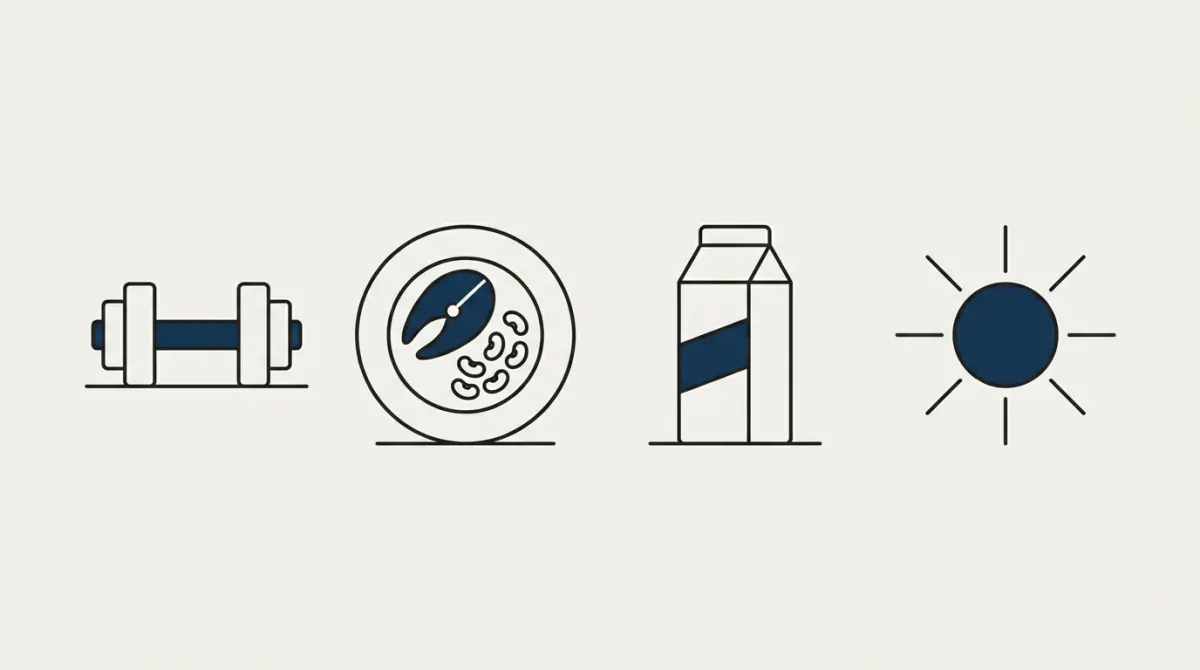
The good news: the interventions that protect muscle and bone are well-established, cheap, and work.
1. Resistance training, 3x per week. Lifting is the single strongest signal telling your body to keep muscle and bone while in a deficit.4 Prioritize compound movements — squats, deadlifts, presses, rows. Walking is great for health; it does not preserve muscle in a steep deficit.
2. Protein at 1.2–1.6 g per kg of body weight daily. This matches ESPEN/PROT-AGE clinical guidelines for muscle preservation.45 For a 90 kg (200 lb) person, that's 110–145 g of protein per day — hard to hit when your appetite is switched off, which is why it must be deliberate: protein first at every meal.
3. Calcium and vitamin D. 1,000–1,200 mg calcium and 1,500–2,000 IU vitamin D3 daily (food first, supplements to fill gaps) to support bone remodeling while density is under pressure.67
4. A baseline DEXA scan — before or soon after starting. A DEXA measures fat, lean mass, and bone density directly.13 Without a baseline, neither you nor your clinician can see whether your weight loss is fat or self-cannibalization. Scans typically cost $50–150 cash and take 10 minutes. If your prescriber has never mentioned body composition, that tells you something about the quality of your care.
The uncomfortable truth about one-click prescriptions
GLP-1s have never been easier to get — a few forms, and a vial ships to your door tomorrow. What the fastest telehealth channels rarely ship alongside the drug: a protein target, a training plan, lab work, or any body-composition monitoring at all.
Clinicians who inherit these patients report a consistent pattern: extreme weight loss in a short timeframe, no strength work, minimal protein — and irreversible bone loss on the scan.8 The drug did exactly what it was designed to do. The care was missing.
If you're choosing where to get treatment, the checklist is simple: does the provider ask about your training and protein intake? Do they order labs? Do they measure body composition, not just weight? If the answer is no three times, keep looking. Our provider reviews and program ranking grade on what each one actually includes.
FAQ
Does Ozempic cause muscle loss? Weight loss on semaglutide includes significant lean mass loss — potentially 25–40% of total weight lost — unless countered with resistance training and adequate protein.12 The drug doesn't "eat muscle" directly; rapid caloric deficit does.
Can GLP-1s cause osteoporosis? Rapid, unsupported weight loss on GLP-1s can meaningfully reduce bone density (−2.6% at the hip in one year in one RCT).3 In vulnerable patients, that can tip into osteopenia or osteoporosis, which is largely irreversible.
How do I keep muscle while on a GLP-1? Resistance training 3x/week, 1.2–1.6 g/kg/day of protein, adequate calcium and vitamin D, and a weight-loss pace your clinician confirms is appropriate.4567
Should I get a DEXA scan before starting? Ideally yes — it's the only way to know what your weight loss is made of and to catch bone loss early.13
This article is for information only and is not medical advice. Talk to a licensed clinician before starting, stopping, or changing any medication or training program.
- 1.Body composition changes during weight reduction with tirzepatide in SURMOUNT-1Look et al., the DEXA substudy at 72 weeksDiabetes, Obesity and Metabolism↩
- 2.Changes in lean body mass with GLP-1-based therapies and mitigation strategiesNeeland et al., which pools the DEXA substudies including STEP 1Diabetes, Obesity and Metabolism↩
- 3.Once-weekly semaglutide versus placebo in adults with increased fracture riskHansen et al., hip and spine bone mineral density over 52 weekseClinicalMedicine↩
- 4.Protein intake and exercise for optimal muscle function with agingRecommendations from the ESPEN Expert GroupEuropean Society for Clinical Nutrition and Metabolism↩
- 5.Evidence-based recommendations for optimal dietary protein intake in older peopleThe PROT-AGE Study Group position paperJournal of the American Medical Directors Association↩
- 6.Calcium: fact sheet for health professionalsRecommended intakes for adultsNIH Office of Dietary Supplements↩
- 7.Vitamin D: fact sheet for health professionalsRecommended intakes and upper limits for adultsNIH Office of Dietary Supplements↩
- 8.The new peptides story: how GLP-1s are changing mental healthNikita Tsimmer of Fountain Health on patients arriving from one-click telehealthDLD Health↩
NADAC figures are pharmacy acquisition costs, not retail prices and not what you will pay. This content is educational and is not medical advice.